
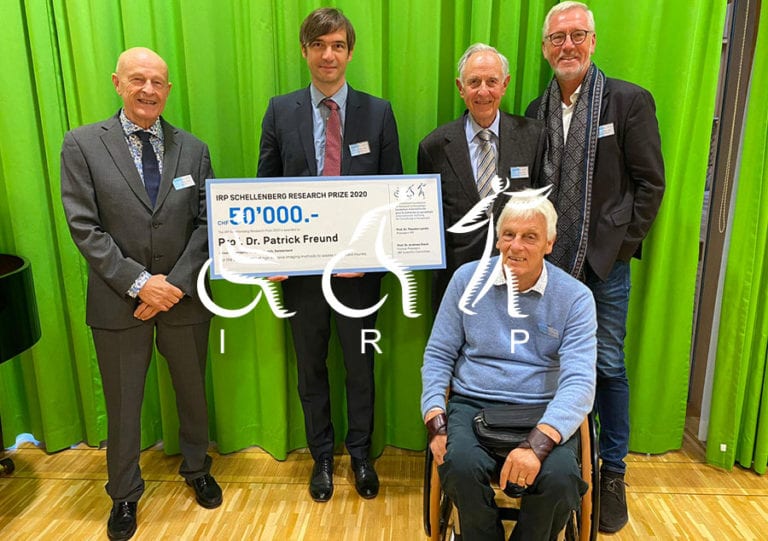
Two renowned scientists receive the IRP Research Prize
IRP: Prof. Freund, for which basic research work did you receive this prize?
Together with Eric Rouiller and Martin Schwab, I initially conducted research on Anti-Nogo-A, and we were able to demonstrate in a primate model that nerves can regrow. I then conducted research in the field of neuroimaging at Queen Square in London. I was subsequently able to apply the MRI biomarkers identified there in a long-term study in Zurich, in which we used imaging techniques to investigate neurodegenerative changes in the spinal cord and brain.
What is the underlying principle?
Our work has shown that nerve tissue in the spinal cord degenerates both below and above the spinal cord lesion, as well as in the affected regions of the brain. Furthermore, thanks to our research, we now know that neurodegenerative microstructural changes continue to progress for years after the trauma has occurred.
What are the benefits of these biomarkers?
The aim is to use MRI sequences to document these changes and, by comparing MRI sequences, predict how quickly degeneration progresses. This allows us to predict the individual recovery potential of patients with spinal cord injuries at an early stage and with a high degree of precision, as this correlates directly with the extent of neurodegenerative changes at the outset. The lower the initial level of neurodegeneration, the greater the potential for clinical recovery. This method also enables us to assess the effect of an antibody against the growth-inhibiting Nogo-A protein following acute spinal cord injury.
You are both a biologist and a physician. Where does your interest in paraplegiology come from?
It was a fortunate coincidence that, as a biologist, I had the opportunity to conduct research in the field of paraplegiology with Eric Rouiller and Martin Schwab. Yet I had already grown up with the subject, as I had an uncle who was paralysed following an accident. As a child, I would always pinch his leg and could not believe that he could not feel anything. Even today, my contact with patients with paraplegia continues to make a strong impression on me. I particularly appreciate their altruistic support of our research projects, which will ultimately benefit future patients.