
Step by Step:
PARA Talk 2024
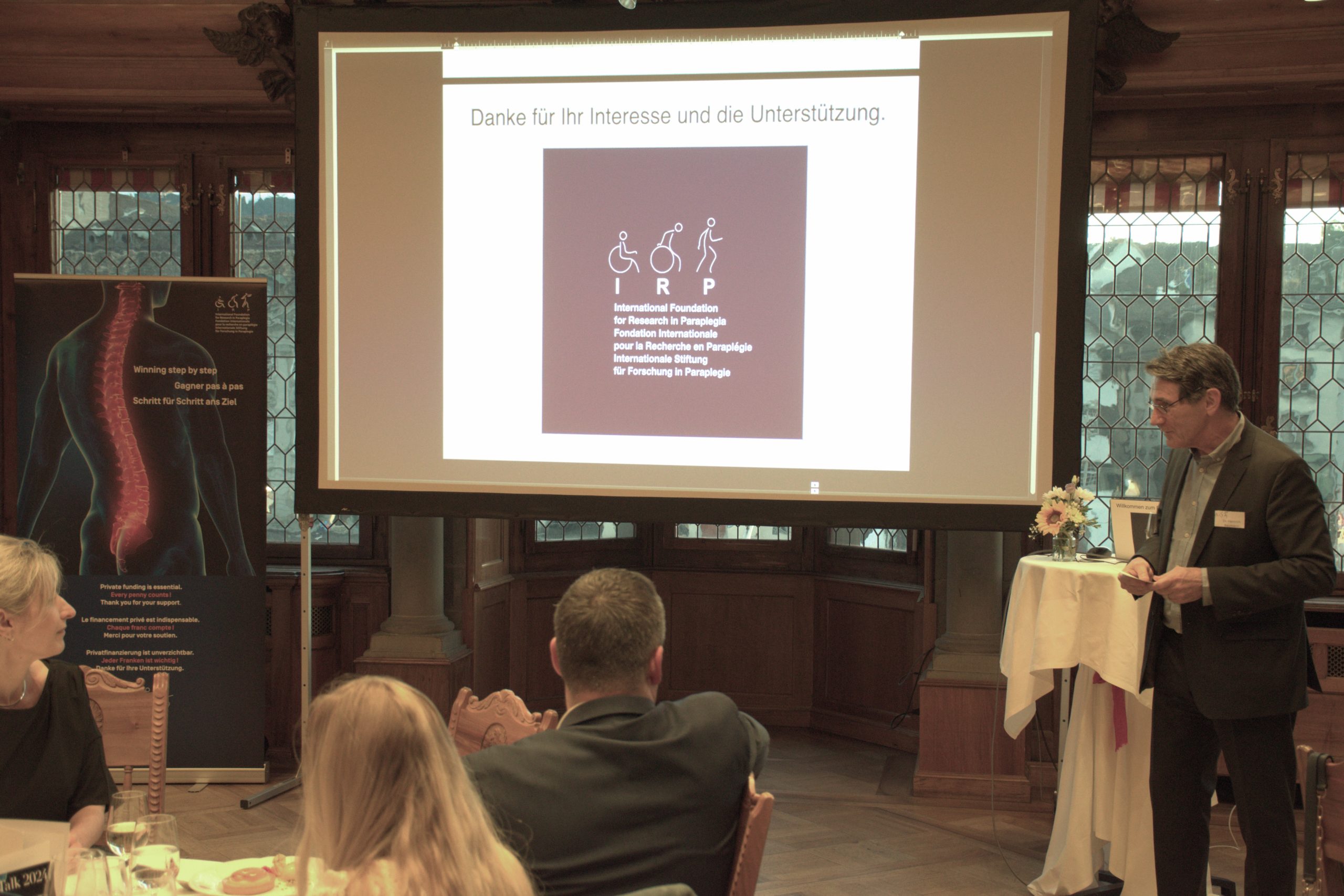
Nogo-A antibodies work. They are capable of partially regenerating injured tissue in the cervical spinal cord of people with incomplete tetraplegia. Prof. Dr Patrick Freund presented this partial success at the PARA Talk held on 4 July by the IRP – International Foundation for Research in Paraplegia. Thanks to this event, net proceeds of over CHF 20,000 will benefit further basic research.
The beautifully decorated hall on the second floor of the now wheelchair-accessible Zunfthaus zur Zimmerleuten on Zurich’s Limmatquai was well attended. Guests from the fields of research and business, as well as donors and sponsors, learned that even a small amount of regeneration of the spinal cord can make a significant difference. People with incomplete tetraplegia and spinal cord injuries become more independent in their everyday lives and careers when their largely paralysed hands and arms regain at least some functionality. Philipp Kutter, a member of the National Council who also has tetraplegia and was present at the event, listened attentively.
Spinal Cord Regeneration Remains the Goal
Nogo-A antibodies promote functional recovery in patients with incomplete spinal cord injuries, as has now been demonstrated in a Phase II double-blind study. A total of 127 patients from across Europe with recent spinal cord injuries in the cervical spine participated in the study. Those who received the active substance rather than the placebo showed better functional recovery. This was also the case when compared with extensive data on the course of recovery collected since 2001 (EMSCI data). Prof. Patrick Freund reported these findings with satisfaction. At the same time, he pointed out that there is still a long way to go before Nogo-A antibodies can be approved for the treatment of acute spinal cord injury. However, the regeneration-focused approach discovered by Prof. Martin Schwab and supported early on by IRP remains unique and promising.
Neurosurgery Supports and Accompanies the Process
On the long road towards regeneration of the injured spinal cord, surgical interventions such as those developed by French scientist Grégoire Courtine together with neurosurgeon Jocelyne Bloch also offer promising possibilities for people affected. In this approach, electrodes are used to bridge the site of injury or to stimulate the spinal cord in such a way that certain functions can be partially restored. Wheelchair athlete and sports teacher Dave Mzee spoke about this in a lively and engaging manner. Having sustained an incomplete tetraplegic spinal cord injury in an accident, he underwent such an operation after his initial rehabilitation. Following extensive training, he can now walk several hundred metres again using a walker. However, it is strenuous. He gave his presentation from his wheelchair.
Further research also remains demanding. It is financed almost exclusively through private funding. The IRP Foundation continues to depend on the generous support of donors and sponsors. Only with this support can its highly qualified Research Council select the best projects from among the many submitted.
Thanks to the interested participants, donors and sponsors, net proceeds of more than CHF 20,000 are available for research. Thank you very much!
IRP Zürich, Tel. 078 218 14 84, E-Mail: research@irp.ch, www.irp.ch
IBAN: CH48 0875 5056 6191 0010 0, Banque Pictet & Cie SA, Gen
PARA Talk 2024


